
Negative Capabilities
On AI summaries, college essays, and letters in peril.

1 :: “This appears to be a long document. Save time by reading a summary using AI Assistant.” No doubt you are seeing variants of such sentences with increasing frequency, offering help, welcome or unwelcome, in navigating the digital currents that flood our attention and threaten to carry us away. As Artificial Intelligence flows into every affordance our screens display for our convenience, distraction, inspiration, and productivity, such messages signal its ubiquity and foretell—perhaps “describe” is the better word by now—its insidious purchase on the shape and substance of our knowing.
The two sentences I quote appear at the top of every document I open in Adobe Acrobat, a proficient piece of technology that allows for the display and management of PDFs. In recent months, they’ve greeted me many times each day. Let me explain: after years—decades, at this point, if I take the time to do the math—of hoarding my old journals as their once fluid thoughts slowed to stillness beneath films of dust and forgetfulness, I decided to digitize them. The project’s impulse, if the motivation for something so long delayed can be so labeled, was to preserve in more compact form the contents of the nearly three dozen fat three-ring binders that held the journals in annual installments, thereby making their myriad pages—processed through a variety of typing mechanisms across an era of changing technologies—easily accessible via search. My first purpose, which may prove futile, is to make it easier to revisit interests that had animated, and been animated by, my past reading and writing in the hope of fueling future efforts on both those fronts as creative élan becomes constricted by the modesties imposed by old age. Also—and this second purpose will surely be served—I wanted to give our daughters an elegant way out of the conundrum they will otherwise face when the time comes to dispose of the paper portion of their dad’s remains; more practical to place a collection of small files on a thumb drive, or to set them adrift weightlessly in the cloud, than to make space to store the physical archive in an attic, basement, or storage unit, or, worse, to agonize over the decision to consign them to a dumpster. The tiny digital avatars I’ve conjured via scanning will serve memory well enough when my progeny are prompted by an urge to send a wistful or loving nod toward their father’s word-besotted life, which is frankly enough honor for me on that score.
In any case, several thousand of these journal pages now sit on my computer in orderly PDFs, and I can peruse them effortlessly thanks to the surface simplicity and underlying complexity of the Acrobat interface. Collectively, these pages document the reading, writing, and worrying of one sort or another I did during the twenty years I contributed, month in and month out, to the book catalog I published as the stimulus for the associated bookselling business that provided my livelihood at that time. Further installments, covering periods of shorter duration on both sides of those two decades, have also weathered the electronic upgrade with no loss of fidelity (except in terms of the tactile solidity they once possessed), so I can now potter to my heart’s content around a good portion of the garden my life of letters has cultivated.
The journals were part composition notebook and idea repository (many of the false starts in both categories are, gratifyingly, alert with energy when I stumble on them now, poems and essays never to be written but nonetheless vivid to older eyes that can recognize and at times admire the aspirations of a younger self, if not the lack of industry that left them unrealized); and part—the larger part—commonplace book, a record of arresting passages from the varied books I tackled, a kind of seed library preserving impressions and imagery that, through the intervening years, have ramified into forests of attention—call them neural networks if you like—in which my mind continues to lose and find itself.
Like a banner above every single display of these assembled memories the same legend hangs: “This appears to be a long document. Save time by reading a summary using AI Assistant.” Which I, trained to conjure through close reading what words convey in the fuzzy logic of their passage, recast in context to say: “You appear to be living a long life. Would you like to shorten it with a summary?”
2 :: What’s lost in substituting summary for fuller engagement with a text? In Marion Milner: On Creativity, his compact study of the British essayist and psychoanalyst who wrote perceptively, among other themes, about the uses we can make of our reading,1 David Russell writes that anyone interested in the profound insights literature can engender
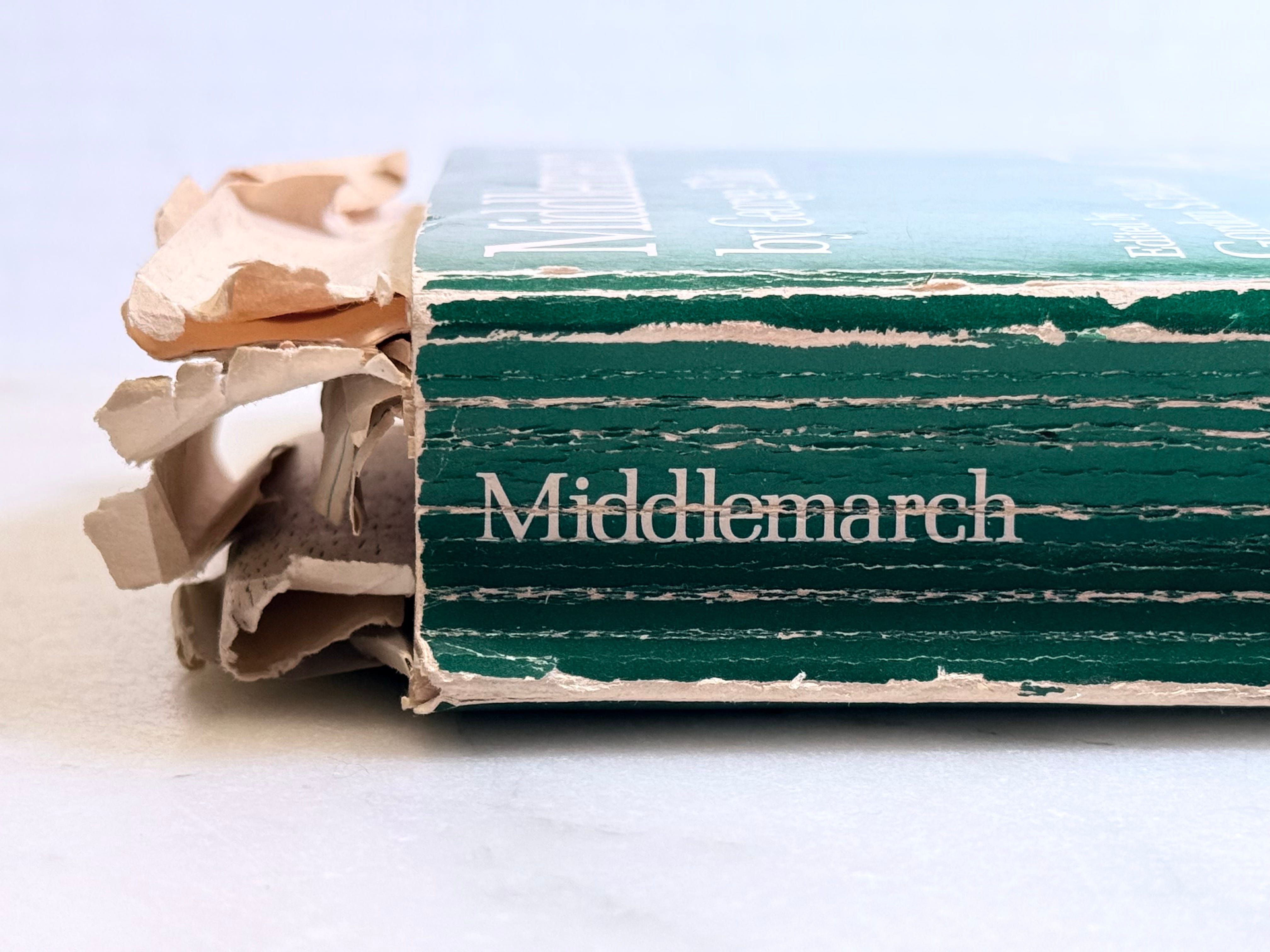
will notice pretty quickly that these insights are difficult to summarize. Although some people, for instance, have credited a book like Middlemarch with changing their lives, no one has had this reaction to a summary of its plot.
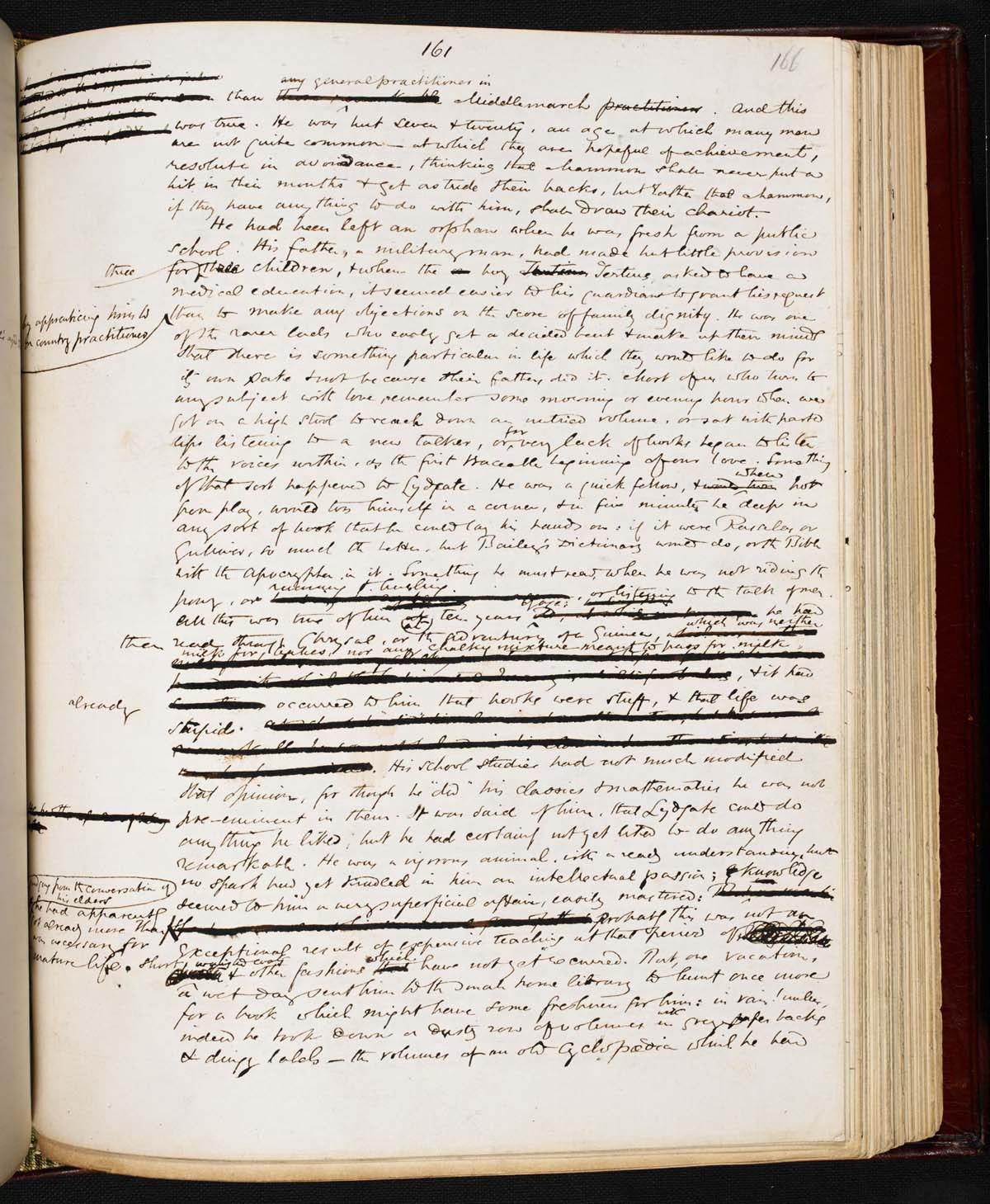
I am one of the readers on whom Middlemarch, published in 1871, has had an effect not only profound, but prolonged. I first read George Eliot’s Victorian masterpiece when I was nineteen, as part of a college course on the novel taken in the spring semester of my sophomore year. At the time it struck me as the wisest book I’d ever read. In the half-dozen or so revisits I’ve enjoyed in the intervening half-century (so impressive was that first encounter, I kept returning to Eliot’s prose to check my soul’s pulse), its wisdom grew to complement, even as it continued to outpace, my experience.2
A vast portrait of a provincial city set some four decades before its writing, Middlemarch has at its center the story of Dorothea Brooke, a “home epic” of a bright, brave young woman learning how to live and what to live for—as convincing a portrait of the romance of being earnest as anyone has ever penned. As Eliot charts Dorothea’s awkward progress through stages of disappointment and regret to an unexpectedly empowering embrace of life’s limits, she sets in motion around her protagonist an expansive, absorbing dance of characters and subplots. If the novel’s six hundred plus pages taught my student self more than I would learn in any classroom, its unfolding of further lessons in future readings helped steady my balance in the unsteady wider world.
My college copy of Middlemarch—a purely functional academic edition with no physical allure, beribboned with dozens of slips of paper marking favorite passages, entire sections broken free from the tired glue of the volume’s binding by dint of so many re-readings—sits on the shelf behind me still, a treasured relic of my reading life. And more than that: it is a talisman of my writing life as well, courtesy of the assignment attached to my first reading of it. To fulfill that requirement, I composed a short essay in which headier notions than I was usually able to set down orchestrated themselves across eight pages with a sense of melody I’d never tapped before, revealing in its themes what I’d mutely gleaned during my week of absorption in the what-happens-next-ness of Eliot’s intricate plot, putting into words ideas I couldn’t have been sure I had. Memorably—it fills me with some wonder even now—I reached the conclusion of the paper to witness thoughts resolve themselves, in the essay’s concluding clauses, into phrases whose cadences carried what was for me a new kind of expression, echoing with import larger than any I had actively attempted to formulate.
In the resonance of that final sentence, I sensed obscurely but with surety how I might use reading toward unprojected ends, to follow it ultimately toward a kind of writing that, back then, I only inchoately aspired to do. Just as a plot summary of Middlemarch delivers none of the wisdom that engrossment in the novel might discover, no summary of that already brief college English essay could encapsulate what the composition of it would converge for me; nor, aside from the fact that I’ve preserved them all these years, would any consideration of its eight pages—typed on a Smith Corona portable on Eaton’s Corrasable bond, which retains to this day its trademark surface, glazed with a coating creepy to the touch but ensuring easy erasure—suggest anything more than a well-executed class assignment. But the experience of that writing, like the experience of reading Eliot’s slow and, by my measure, never-ending fiction, transformed my understanding of my capacity. Both intimated that the life of letters, writ large, was more than the production or conveyance of content, that it might share something of the character Claude Levi-Strauss, in Tristes Tropiques,3 ascribed to exploration: not a covering of surface distance but a deeper presence, an alertness inspiring an exercise of mind not ponderous but pondering, not so much active as attending, in which a fleeting utterance, a turn of phrase, might encounter meaning in its making.
3 :: My professor for the course in the novel in which I met Middlemarch gave me room to discover such things; she was amused, I think, and somehow buoyed, by my determinedly wayward diligence. A large part of good teaching is persuasive listening, a granting of permission without prescription in a manner that encourages in a student an unvoiced urge to live up to the aspiration inherent in the allowance. Such undirected tutelage is likely a foreign language for both instructors and instructed today, hellbent as education has become from the earliest grade levels—regardless of the predilections of teacher and taught—on datafied measures of mastery and objective assessments of progress more suited to machines than minds.
Yet perhaps, as the world now argues (when it doesn’t insist), the distinction between machines and minds is overblown? Let’s face it, AI can write high school and college essays every bit as good as—no, consistently better than—those of most students. Indeed, the first headlines that heralded the advent of ChatGPT seemed stuck on sounding the death knell for such exercises, striking terror into the hearts if not the minds of habitués of the academy and driving yet another nail into the coffin of the zombified liberal arts, already entombed—in popular punditry if not the minds of the populace itself—in the shadows of higher education, escaping twilit libraries only to skulk across campus from time to time for a soporific seminar, a political protest, or a wine reception. Such characterization of the humanities is wildly unfair, of course, but no less prevalent in public palaver for that. Why think about thought when machines can more prolifically—and profitably—index and imitate its airy nothings?
But let’s linger a moment longer on those early alarms about the end of the high school English theme or the extinction of the college admissions essay. Given my revelatory experience on the eighth and final page of an essay I composed fifty years ago on a novel that was then a century old, one might think the fatal threat to such exercises might have given me cause for mourning. But something closer to the opposite turned out to be the case. The endangered genres of student writing identified in the first flush of opinion pieces prompted by ChatGPT’s wizardry seemed to be setting the bar pretty low for the admittedly astonishing generative mechanism, since both—in the critical posturing of the English-class paper and the college application’s apologia pro vita sua for a life not yet lived—had devolved through generations of mutation, shaped by instructional rubrics and coaching guidelines into predictable miscellanies of a little learning, spurts of untethered speculation, bits of sanctioned mimicry or unwitting pastiches, and tracts of empty but plausible verbiage aimed—with often high-priced precision for those able to afford it—at systems complicit in their own gaming. Using the lens of such writing to judge the power of ChatGPT and its ilk is not to spotlight technology’s power, I’d argue, but to reveal the failures of education in its focus on composition as a means to prescribed ends rather than as a mode of learning in its own right, a medium of discovery that can make the voice inside one’s head more supple, resourceful, and sustained, more alert to facts and more nourished by fancies, and thereby more attuned to the worries and wonders of what’s outside its immediate ken.
So, on the one hand, I think it’s easy to overdo pessimism about the current situation, at least outside of classroom settings; the more one engages seriously with AI, the more apparent it becomes that creativity might find new means to flourish in the technology’s glow. Why not think of LLMs as tools of access rather than output, supplying us entrée to, and agency within, an evolving encyclopedia in which knowledge is scouted in new ways, with all the vigilance such exploration has always required? Call ChatGPT or Claude the love child of Denis Diderot and Jorge Luis Borges, and hope it might develop the wit of either of its forebears, or somehow engender it in us.
On the other hand, there is a larger loss that the technology embodies as a symptom—perhaps as a fulfillment of symptoms—rather than a cause, a loss that began generations before the advent of generative AI. What was once the design of the humanities, the underlying and often unacknowledged motive force of the rhetorical armature and scholarly apparatus that attended them through the formation of their traditions—a reflective poise nurtured by powers of expression, if not eloquence—has long ago been overwritten in a grammar of academic credentialing and résumé building that extends little credit to sentences that fall outside its utilitarian syntax. The result has been the translating of much education, and writing pedagogy in particular, from one language—heuristic and inherently emergent—to another—predictive and determined. Composition has thus come to fledgling students as a formulaic enterprise, reduced to the sum of five paragraphs that follow a well-marked trail from topic sentence to conclusion and prepared to fit unbending models of discourse: narrative, expository, persuasive, etc. No wonder fewer and fewer fledglings have learned to fly.
Somewhere in the translation, the essay, engendered and named by Montaigne as an attempt or a trial, lost its pursuit of meaning across a page with no direction until one was discovered. What began as a form in which the promise of letters—handily defined by Keats some two centuries after Montaigne’s death as negative capability: “capable of being in uncertainties, mysteries, doubts, without any irritable reaching after fact and reason”4—might be filled by its enactment has by now reached a kind of senescence in a set of checkboxes, mnemonic devices in which the vitality of neither promise nor enactment are remembered.
The threat to writing—I’ll leave AI’s greater perils to minds less anchored to pages than mine—is not that ChatGPT and allied technologies are taking the efforts traditionally demanded of high school and college students as a benchmark they can readily surpass, but that they are, in the labyrinthine internal referencing of LLMs, taking them as inspiration, thereby condemning their language to a recursive loop. Their outputs are predicated upon systems for which negative capability is not a factor: every question has an answer, every prompt an output. The systems don’t know how to say, “I don’t know,” much less invent an appropriate response to such a state of being.5 The robotic apocalypse that threatens us is not one filled with unliving creatures; it is one in which dead language starves the expression that shapes what sense we can make of our presence in a mortal world. The danger is not that we’ll unlearn how to say what we mean, but that we’ll mean less.
Three books Milner originally published under the pen name Joanna Field—A Life of One’s Own (1936), An Experiment in Leisure (1937), and On Not Being Able to Paint (1957)—rank, along with David Russell’s superb monograph, among my most rewarding reading over the past two years.
My last time through the novel, I listened to the audiobook performed by Juliet Stevenson, which I highly recommend.
In an early chapter called “Looking Back,” Levi-Strauss writes:
Exploration is not so much a covering of surface distance as a study in depth: a fleeting episode, a fragment of landscape or a remark overheard may provide the only means of understanding and interpreting areas which would otherwise remain barren of meaning.
From a December 1817 letter from John Keats to his brothers:
. . . at once it struck me what quality went to form a Man of Achievement, especially in Literature, and which Shakespeare possessed so enormously—I mean Negative Capability, that is, when a man is capable of being in uncertainties, mysteries, doubts, without any irritable reaching after fact and reason—
See OpenAI’s technical research paper, Why Language Models Hallucinate, and Nick Potkalitsky’s non-technical commentary upon it: The “I Don’t Know” Problem: Why OpenAI’s Latest Hallucination Research Misses the Mark.
… I’ve been thinking about this too (!)… as the marinating, waiting for content to gel seems to be more and more an internal argument between; ‘Wait for ripeness’ and ‘Get it clear’. Maybe this has become an awful retelling of the 2 wolves ( the one you feed gets the oomph)-
But, as ever, you honor more the wanderer, the holder of the ball of string in the maze above the trophy at the end. Thank you - and Happy holidays. amigo.
Currently writing a college essay on the loss of writing's originality, as you describe. I find myself returning to Orwell, whose "Politics and the English Language" outlines the failure of such constricting models of writing with a clairvoyant sense of anticipation. It seems as though AI has accelerated an already lost cause. Thank you for the inspiration with this piece; although, of course, I'm only going off what my AI-assisted summary tells me.