
Inside Hamlet’s Head
On the syntax of soliloquy and the work of words.

Even as we watch a stage production, from a seat in an audience of a thousand people, we experience much of Shakespeare’s most famous tragedy from inside the head of its protagonist. Or so it seems: the intensity of Hamlet’s grief and confusion, the urgent anguish of his procrastinated action, the resonance of the language that animates the meter and matter of his soliloquies—these intimacies conspire to envelop us in a fraught realm of self-absorption set off from the frenetic scheming that advances the action, an interior landscape as frighted and as undiscovered as the land beyond life he invokes in his most brooding and remembered speech.
                     Who would fardels bear,
To grunt and sweat under a weary life,
But that the dread of something after death,
The undiscovere’d country, from whose bourn
No traveller returns, puzzles the will,
And makes us rather bear those ills we have
Than fly to others that we know not of?
For a 2025 podcast production, Jeremy McCarter and his audio storytelling company Make-Believe Association immersed their version of Hamlet in this quality of interiority, creating a theatrical space best entered, as listeners are advised, through headphones. Make-Believe’s telling of the tale suspends our disbelief literally between the prince’s ears: every word we hear, in real time or in retrospect, has been heard by Hamlet, as has every strain of music and every sound effect deployed. The action is advanced carefully through scenes in which Hamlet is present or—when dramatic developments unfold outside his earshot—whose import is rehearsed to him at some point in the original play. Such narrative contrivance requires structural ingenuity to meet the demands of the entangled plot, but no violence is done to Shakespeare’s drama, nor to the playwright’s words.
In addition to the voices of a talented ensemble of actors, led by Daniel Kyri in the title role, Make-Believe’s realization of the text marshals the forces of a cast of virtuosic microphones, their sensitivities calibrated by sound designer Mikhail Fiksel, who, in collaboration with director McCarter, orchestrated the recordings into what becomes, for the headphoned audience, an atmospheric, often claustrophobic, soundscape. The inner turmoil the drama usually enacts upon a stage is conveyed by non-verbal elements that complement the expressiveness of the language, enriching it with a spatial confidentiality: we hear with Hamlet the rumbling of the milling court in the background of his thought, the echo of footfalls, his inhalations and exhalations at moments of distress, at times—when his wits are overcome with the emotions they contend with—the insistent rhythm of his pulse.
Even the sea off Elsinore’s rocky shore, to which McCarter has the inspiration to lure the distraught Hamlet in his moment of deepest quandary, is sonically captured.1 Hurrying from the castle and all it holds—we know his speed and intent from the pounding of both feet and heart, the panting of his respiration, the lap and slosh of waves as they crash about him—he is pulled into the riddling tide set in motion by the question that he pursues, or that is pursuing him: “To be or not to be?” The literary wonders attendant on that phrase in the thirty-two lines that follow are delivered once the splash and chatter of the surf subside and the thoughts that come to him are enveloped in the palpable stillness of submergence, suspended in an eddy of introspection by the buoyancy of words—until the spell is broken and time calls him to the surface, coughing up brine and gasping for air.
It is a theatrical tour de force, and a technological one: the aural capacities of modern recording apparatus extend the imaginative dimensions of Make-Believe’s stage, just as the physical resources of the Elizabethan playhouse had extended Shakespeare’s creative range. Helen Hackett, author of The Elizabethan Mind: Searching for the Self in an Age of Uncertainty, has pointed out how recently the kinds of theaters that created demand for the works of Shakespeare and his fellow dramatists had come into existence, calling them “almost a new kind of technology of the imagination”—a medium possessing novel capacities that altered conceptions of what, and how, a story might be presented, and that called forth fresh responses from playgoers.
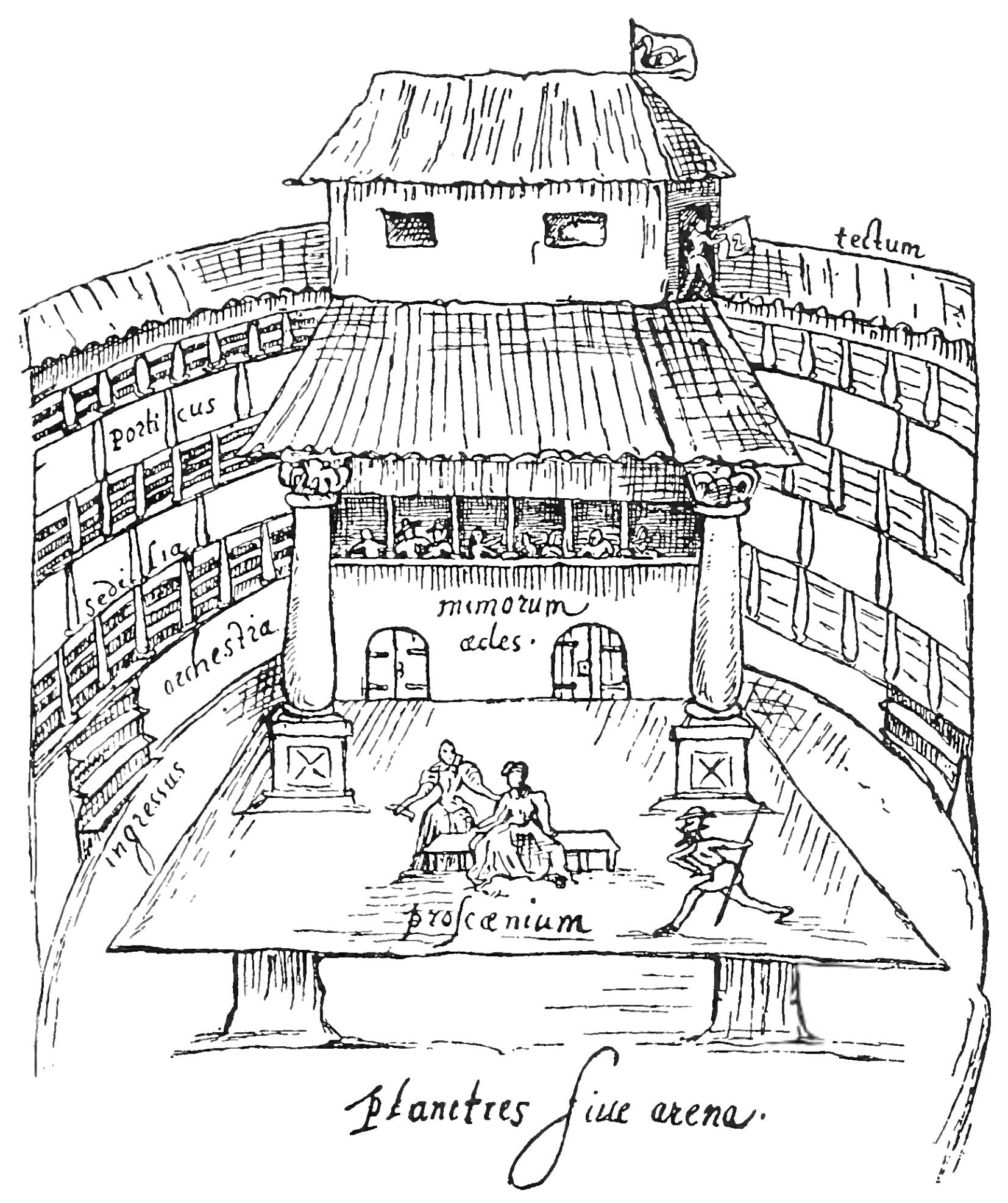
In the circular or polygonal space of these playhouses, Hackett said in a 2022 interview,
we think up to 3,000 people gathered. They’re all focused on the stage, working in collaboration with the words of the playwright, the performance of the actors. They can make virtual worlds, they can make a kind of virtual reality. And I think Shakespeare and his colleagues were experiencing this, as audiences were, as a new kind of exhilaration.2
The “virtual worlds” the playhouses conjured were programmed, largely, in verse. In Dark Renaissance: The Dangerous Times and Fatal Genius of Shakespeare’s Greatest Rival, his life of the Bard’s precocious contemporary and creative precursor, Christopher Marlowe, Stephen Greenblatt writes:
Elizabethan listeners counted on the language of the plays to do what spectacular scenic effects and lighting do in the modern theater: enhance illusion, heighten emotion, and excite the imagination. That is why Elizabethan drama from its inception was written largely in verse. But the verse that was initially ground out was almost comically inept.
Marlowe changed that, beginning with his play, Tamburlaine the Great, first performed in 1587 or 1588. If the quasi-historical title character conquered his world through vigor, military genius, and an ambition at once unbridled, ruthless, and sublime, the author commanded the audience’s attention through the unprecedented confidence of his poetic line: an unrhymed iambic pentameter strong and supple enough to supply the playhouse’s virtual realities with reverberating immediacy:
Nature, that framed us of four elements
Warring within our breasts for regiment,
Doth teach us all to have aspiring minds:
Our souls, whose faculties can comprehend
The wondrous architecture of the world
And measure every wandering planet’s course,
Still climbing after knowledge infinite
And always moving as the restless spheres,
Will us to wear ourselves, and never rest,
Until we reach the ripest fruit of all . . .
               — Tamburlaine the Great, Act II, Scene VII
In Tamburlaine and other plays, Doctor Faustus especially, Marlowe brazenly expanded the compass of literary and dramatic invention to represent on stage, in Greenblatt’s words, a “powerful, complex inner life,” thus generating an artistic resource that, while familiar today, had not been readily deployed before, in which the reflections of a figure talking to himself assumed the force of action. Marlowe activated this resource, Greenblatt notes, “largely through the intimacy of the soliloquy.”
Shakespeare was watching. He followed Marlowe’s lead, endowing soliloquies in Hamlet—and Macbeth, Lear, and other plays—with such gifts of expressive scrutiny and secretive exposure that he outstripped his rival’s achievement in fashioning distinctive introspective silhouettes. If the soliloquy became the insignia of Shakespeare’s eminence in the world of letters, “To be or not to be” has remained a hallmark of his artistry. The six words with which the speech begins are as simple, and as famed for their heralding of deep themes, as the four notes that announce Beethoven’s Fifth Symphony; both motifs resound—as the composer characterized his musical salvo—like fate knocking on the door. From the seeds of the alternative infinitives, metaphors begin to ramify:
To be, or not to be, that is the question:
Whether ’tis nobler in the mind to suffer
The slings and arrows of outrageous fortune,
Or to take arms against a sea of troubles
And by opposing end them.
No matter the particular method of delivery, the prince’s conversation with himself is secluded in a whispered sincerity probing enough to question its own character, angling the ears of eavesdroppers now this way, now that. The composition is so tightly wrought, the aspects of its imagery so prismatic, that, even as the words flow with choreographed grace across enjambments, over the footlights or down the page, their utterance holds the play—for one long moment—spellbound.
					To die—to sleep,
No more; and by a sleep to say we end
The heart-ache and the thousand natural shocks
That flesh is heir to: ’tis a consummation
Devoutly to be wish’d.
One arresting turn of phrase after another transfixes attention as the prince clings to the verbal struts and cross-talk that give stability to his quavering mind.
					To die, to sleep;
To sleep, perchance to dream—ay, there’s the rub:
For in that sleep of death what dreams may come,
When we have shuffled off this mortal coil,
Must give us pause—there’s the respect
That makes calamity of so long life.
It is psychology as expression, in expression, using all the furnishings of language to make tangible the hazards of emotion the stream of thought nourishes, then struggles to contain.
Thus conscience doth make cowards of us all,
And thus the native hue of resolution
Is sicklied o’er with the pale cast of thought,
And enterprises of great pith and moment
With this regard their currents turn awry
And lose the name of action.
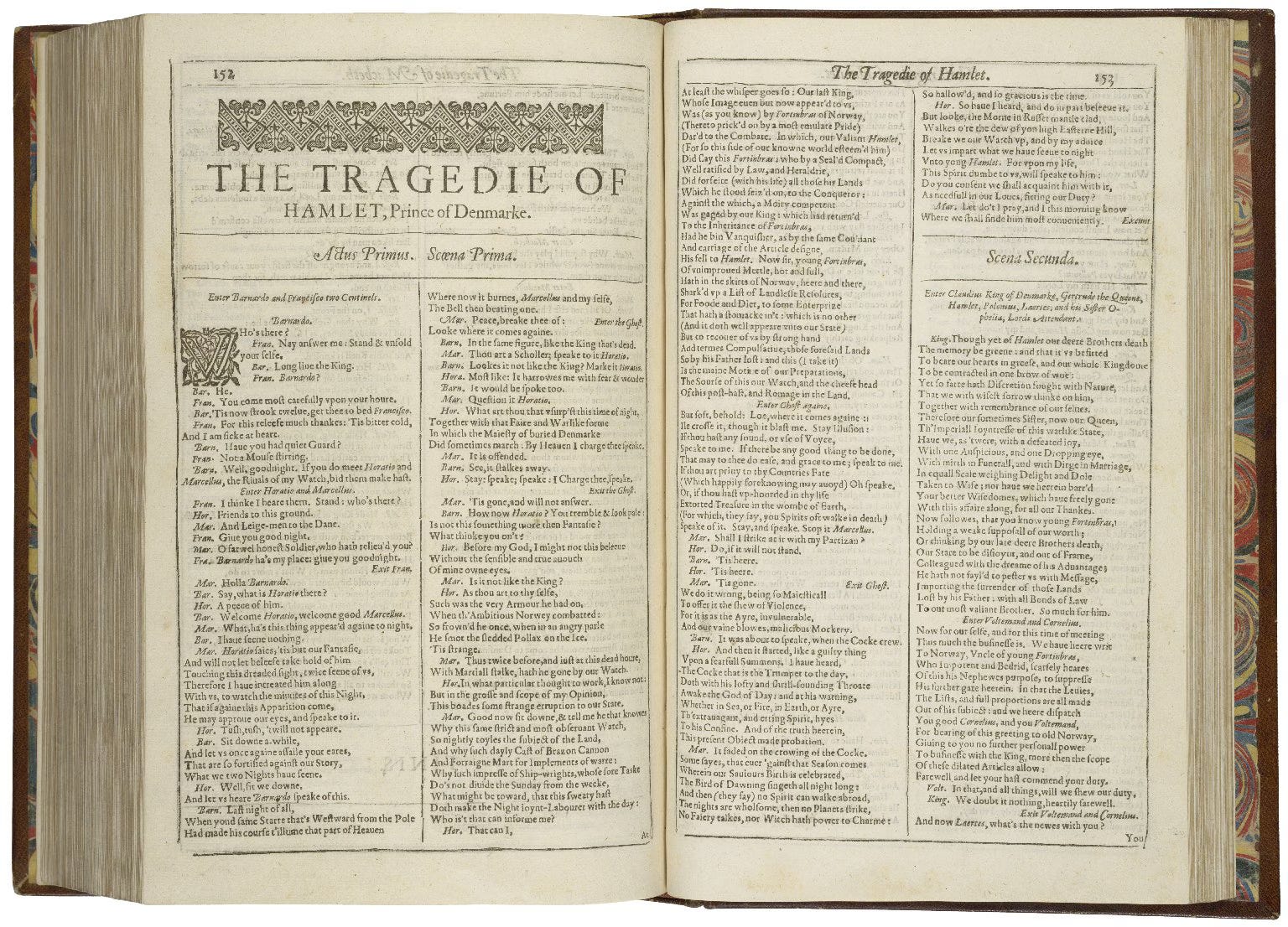
Shakespeare’s psychological acuity is—in every case, but in Hamlet’s particularly—a construction of language. Indeed, his characters are creatures of it: not mouthpieces for ideas, nor emblems of virtue or vice, but actors whose agency (or lack of it) is described by verbal expression in lines that possess, through the contours of their prosody, textural attributes that amplify the text itself. Images adjoin one another with amalgamated artifice, their resonance pulsing through echoes before and after, arresting attention at first hearing and holding it in recollection.
Let’s dwell on the lines of “To be or not to be” a little longer. If the half-dozen ever-quoted syllables that begin Hamlet’s examination of conscience constitute as famous a phrase as any dramatist has composed in English, the pentameters that follow them are lit with figures nearly as marked by their brilliance and afterglow: the slings and arrows of outrageous fortune; the thousand natural shocks that flesh is heir to; a consummation devoutly to be wished; ay, there’s the rub; what dreams may come; when we have shuffled off this mortal coil; the native hue of resolution; enterprises of great pith and moment. What action whose name is lost could measure up to this outpouring of idiomatic ingenuity?
What Coleridge called the prince’s “prodigality of beautiful words” seem, that ill-starred Romantic saw, “the half-embodying of his thoughts, that give them an Outness, a reality sui generis.” It’s a reality both human and modern, one that the soliloquy—its capacities staked out by Marlowe, refined and extended by Shakespeare—set off in a private chamber on the stage of the Elizabethan playhouse, just as Montaigne’s Essays, two decades earlier, had found dedicated room for thinking upon a page.3 Across generations, the speech’s famous phrases have drawn to themselves a reverberant pedigree. As we come upon them now we recognize that inheritance as part and parcel of their accumulated power, so much so that it can be hard to parse their passing without being lulled by their luxurious invention. Language, especially literary language, never marshals all its forces at inception; its meanings evolve over time, accruing the apprehensions of readers and writers who engage in private or public conversation with it, invoking in the encounter with original expression the lessons letters carry into the confusion of experience. The wisdom of words is spelled dynamically.
So present is the soliloquy’s past that “To be or not to be” can be performed as if the lines have been composed before the character begins speaking, the inherited intensity of what follows the opening phrase assumed and embraced from the start, intoned with sonorous inevitability, the speech a euphonious flow of self-generating images and verse. Such performances can be riveting, the interlocking phrases carrying Hamlet’s puzzlements to heights of speech stunning, even breathtaking; yet the sense of vertigo they might otherwise induce can be kept at bay as actor and audience are steadied by the eloquence inherent in the familiar artifacts of quotation both anticipate. The words, for all their wonder, can seem too sure of themselves.
In Robert Icke’s staging of Hamlet, first presented at London’s Almeida Theater in 2017 then captured on film during a West End run the following year4, Andrew Scott delivers the soliloquy as if its words are coming to mind as he is speaking, ignoring the conventional music of the verse—its impulsive forward-motion—to let his thoughts slowly surface and formulate themselves in phrases; as if he is extracting each utterance from the silence of hesitation and uncertainty in which his introspection dwells. His hands are as telling as his voice and face: never still, they slowly gesticulate, flutter, rove about him with no sure direction or intent, as if articulation floated in thin air and might be conjured from it.
“Speech is a gesture,” wrote Merleau-Ponty, “and its signification is a world.” A corollary supposition is that such worlds are never settled but always in formation, for language constitutes as much as describes their character, fitting meanings to moments or positing new ones to attend to the distinctions, however tentative and inexact, that life demands.5 The myriad manners of expression language is called upon to meet, from the mundane and rote to the miraculous and original, means it signifies not by reference to fixed definition but through emergent and shifting senses, through the invocation of powers that are transitional and relational. This is transiently true in normal conversation, determinedly so in considered composition, and most electrically in the heightened speech Marlowe invented for his heroes and Shakespeare elaborated with such genius in soliloquies like those he gives to Hamlet. Spotlit on the stage, these star turns produce dramatic focus of unmatched intensity; beyond the theater, their impact has also been profound. Apotheoses of literary art, they are the most potent manifestations of what might be called the Shakespearean singularity, his uncanny ability to reflect, through the moving surfaces and still depths words realize, the streams of thought a consciousness comprises.6
In Hamlet’s soliloquies, as in those bestowed on Macbeth and Lear, the Richards II and III, Iago and Othello, Prospero and others, language itself is given the name of action as minds in extremis struggle to compose themselves when confronted by quandaries of their own making or, more fiercely, by the mute, intractable indifference of the inhuman universe. They do not so much advance plots as hold them still, creating a space for inwardness to have its say; like Montaigne’s essay, the soliloquy is a literary mechanism for asking existential questions to convey something different, and more expansive, than answers. These speeches don’t take meaning from their endings, but make it in their unfolding, which never ends—one reason that Hamlet, epitome of soliloquizing’s epistemic sway, never leaves the stage for long.7
For earlier installments of A Swaying Form on related themes, see The Haunted Bookroom and Interior Pages.
In Laurence Olivier’s celebrated 1948 film of the play, “To be or not to be” is anticipated by a tracking shot that climbs the winding stairs of a castle turret to arrive at a vista overlooking the sea. The crash of the waves sound as an undertow to William Walton’s score. We see the surf from a great height, until the camera reveals the back of Hamlet’s head, zooming closer and closer, as if leading us toward his inmost thoughts, the preponderance of which Olivier then delivers, with characteristic enunciatory punctiliousness, perched on a stone, his figure outlined against the sky.
My quotations from Hackett are drawn from a conversation about her book, The Elizabethan Mind, featured on the “Shakespeare Unlimited” podcast, produced by the Folger Shakespeare Library. In a later episode of the same show devoted to his audio Hamlet, Jeremy McCarter reports that the earlier Hackett interview had inspired him to reach out to her as his production was in development.
An Elizabethan comparison between stage and page is noted in a passage on sonnet sequences in Hackett’s The Elizabethan Mind. “Thomas Nashe recognised this genre,” she writes, “as a kind of performance, with dramatic potential, when in 1591 he described Astrophil and Stella as a ‘tragicomedy of love’ performed on a ‘paper stage’.”
I am channeling Charles Taylor’s recognition of the constitutive (as opposed to designative) nature of language, and his concept of “linguistic rightness,” both advanced most thoroughly in The Language Animal (2016). (Taylor’s ideas are keenly and compactly considered in the context of generative AI by Gregory Forché in What Does Charles Taylor Say About AI? and How Should a Language Animal Take Up a Language Tool?)
It is this singular ability that gives no little grounding to the grandiloquent assertion of Harold Bloom’s subtitle to his 1998 study, Shakespeare: The Invention of the Human.
The quality and quantity of recent adaptations—from Andrew Scott’s revelatory performance and Make-Believe’s audio incarnation to three 2025 films as distinctive in their inspirations as Sam Crane and Pinny Grylls’s Grand Theft Hamlet, Chloé Zhao’s Hamnet, and Aneil Karia’s Hamlet, with Riz Ahmed in the title role—is astonishing.