
My Back Pages
Annals of Bookselling: A Common Reader No. 1, Spring 1986

For twenty years ending roughly twenty years ago, I published a catalog called A Common Reader, a bookselling enterprise that attracted a surprisingly large and gratifyingly loyal band of patrons. What follows is the first in a series of retrospectives I’ll be sharing in coming months.
Back Pages
“Some people eat like birds, lately I’ve been reading like one.” That’s the opening line of the “Reader’s Diary” that appears on the last page of A Common Reader No. 1. The diary faced the order form, which we were hoping people would fill with some of the titles on offer in the preceding pages, clip out, and mail in with a check (this was before Al Gore invented the internet: the old-fashioned was still the only fashion in vogue). A week or so after we sent the catalogs out—I can’t recall how many that initial mailing entailed—we got our first envelope back. It had somehow been opened en route to us: the order was there, but the check had disappeared. This may have well been a portent, but if so, it took twenty years to come to fruition, which meant hundreds of thousands of orders were received, and a few million books sold and shipped, before fate finally focused its forces to consign the enterprise to an inelegant end.
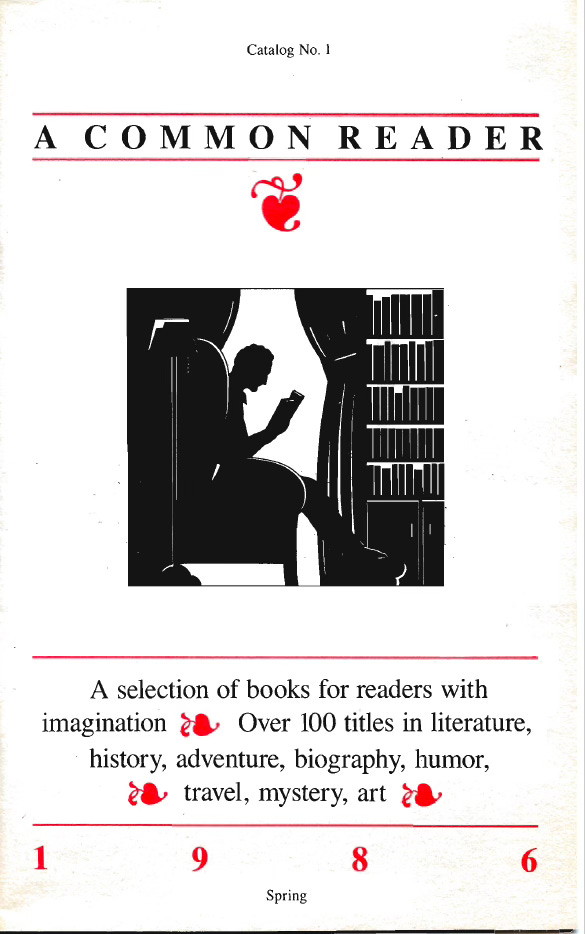
As its cover declared, Catalog No. 1 presented “over 100 titles in literature, history, adventure, biography, humor, travel, mystery, art.” It wore its intentions on its sleeve. “This is our first catalog,” we wrote in the longish letter placed inside the front cover,
in putting it together we’ve selected books we’ve enjoyed and thought you might enjoy as well. Some are best browsed, some are for study, most are absorbing reading—but all belong to that class of books one is eager to pass on to a friend. What’s “common” in A Common Reader is the sense of shared experience a good book can bring to solitary readers. The discovery and delight, the amusements and satisfactions that books provide are a common language to the community of readers we feel part of. . . .
As you’ll see in the pages that follow, our rubrics are various, and the titles gathered beneath them cover a wide range of subject and style; there are diaries and letters, biographies, novels both sweet and searing, books on art and architecture, chronicles of war, collections of essays, memoirs and historical studies, tales of suspense, adventure, and humor. What connects them is the reward they offer a willing reader.
It was, in retrospect, a quaint idea of commerce, but it met a number of personal employment priorities: it kept me surrounded by books; it allowed me to write, but also gave me deadlines to meet to make sure I did; “he sells books” seemed like something my eventual children would understand when they began to wonder what their father did all day, and might not give them pause, or embarrass me, as they got old enough to ponder as well as wonder.
On the page facing our introductory letter, a reader found three offerings with our commentary: volumes one and two of The Lyttelton Hart-Davis Letters (“Letters are the cocktails of literature,” I wrote. “They whet the appetite, fortify one’s sagging spirit, are convivial, and can even serve as the perfect sedative for the mind in bed. Yes, of course, in moderation: too many letters in one sitting and one’s head swims, as with drink”), Tahiti: A Lost Paradise by David Howarth, and Endurance: Shackleton’s Incredible Voyage by Alfred Lansing—a book that would become an ACR bestseller over the years. Flipping forward through the pages, I see several favorites that would later find a place in 1,000 Books to Read Before You Die, the book I would publish in 2018, among them Alice James by Jean Strouse, Footsteps: Adventures of a Romantic Biographer by Richard Holmes (“Biography, at its best, creates a peculiar intimacy among strangers. Author, subject, and reader converge at any point on a page like three perceptions meeting in time. A conversation of sorts proceeds, in one, two, or three voices; that’s part of what makes good biography an imaginative pursuit. Richard Holmes is a biographer . . . and Footsteps is the story of how he came to be one.”), War in Val D’Orcia by Iris Origo, The Recognitions by William Gaddis, The Man Who Mistook His Wife for a Hat by Oliver Sacks, Diary of a Provincial Lady by E. M. Delafield, The Deptford Trilogy by Robertson Davies, Black Lamb and Grey Falcon by Rebecca West, The Histories of Herodotus, The Wilder Shores of Love by Lesley Branch, West with the Night by Beryl Markham, A Palpable God by Reynolds Price.
And others that I had forgotten in the interval, such as the unduly neglected Lord Hervey’s Memoirs, a fiendish insider’s account of the years 1727-1737 in the reign of George II, which exhibits a lordly disdain for, among many other subjects, the ruling monarch, of whom the memoirist comments: “What regard indeed could anybody have for a man who like His Royal Highness had no truth in his words, no justice in his inclination, no integrity in his commerce, no sincerity in his professions, no stability in his attachments, no sense in his conversation, no dignity in his behaviour, and no judgement in his conduct?” I also note Love Among the Butterflies, a vintage piece of Victorian exotica culled from the writings of Margaret Fountaine, who, we told our readers,
used a small inheritance as the measure of freedom to travel in a way few women of her era dared. Her avocation was collecting butterflies, and she seems to have gone everywhere they might conceivably be found. Along the way she found time for other enthusiasms. She was a flirt who wrote delightfully about (among other things) flirtatiousness. Conquests included an Egyptian ship’s captain, an aristocratic Hungarian, and a married Syrian dragoman who proved (for twenty-eight years) her true partner.
There is a portfolio of fifty photographs of a mythological modernist toward the end of his mortal career, Giselle Freund’s Three Days with Joyce, and two early historical novels on scientific themes by John Banville, Kepler and Doctor Copernicus. And there is the Autobiography of Diana Cooper, which tells, like a fairy tale unfolding in real time, the story of a bright, brave, beautiful British aristocrat, who, in addition to her social standing and conquests, became a celebrated star of stage and (early) screen in the 1920s; she used her fame to bolster the political career of her husband, Duff Cooper, who would become Churchill’s Minister of Information during World War II and eventually be named 1st Viscount Norwich.
The selections are, even now, refreshingly rangy: Stephen Millhauser’s inventive novel Edwin Mullhouse: The Life and Death of an American Writer 1943-1954 by Jeffrey Cartwright (“Much of this book’s great wry fun derives from taking literally that heart-breaking secret of American childhood: that every child is believed to be completely innocent of just-ordinariness until proven—by time and alas him- or herself—otherwise”); a small set of books on military campaigns, from Athens and Sparta to Agincourt and Stalingrad; a then newly published historical study by Pierre Darmon called Damning the Innocent: The Persecution of the Impotent in Pre-Revolutionary France; spotlights on the novelists J. M. Coetzee and Isabel Colegate; and The Secret History of the Mongols, an adaptation by Paul Kahn of the Yüan Ch’ao Pi Shih, the only surviving Chinese version of the life of Chingis Khan (c.1162-1227), who in one generation forged an empire out of the nomadic tribes of central Asia and went on to conquer an area stretching from the Adriatic to the Pacific.
A two-page spread labeled “Connoisseurs & Confidence Men” exhibits the curatorial impulse that would become the catalog’s hallmark. It’s heralded with this introductory paragraph:
Collecting is a mania, whether the object of attraction be books or buttons; when it’s works of art, the mania can reveal itself in ways cultured or criminal. Connoisseurs, of course, are those who’ve made collecting itself into an art, thus contributing—wittingly or no—to the creation of a market quite lucrative to those whose art is guile: thieves, forgers, smugglers, and well-heeled confidence men with eyes more sharp for profit than paintings. The books below range from suspenseful to scholarly, the reading from light to serious, but all frame the art world, old and new, in surprising lights.
For humor, there is Jerome K. Jerome’s singularly funny Three Men in a Boat; for nature writing, books by Edward Hoagland; for mysteries, novels by, among others, Nicolas Freeling and Susan Kenney. A reader of that first issue would also come upon assorted celebrations of human linguistic ingenuity, from John Ciardi’s Browser’s Dictionaries (which, when the books went out of circulation some years later, we would return to print in our own editions) to A B C Etc: The Life and Times of the Roman Alphabet by Alexander and Nicholas Humez. My commentary on the latter title began:
There are those, like myself, who view alphabets as the greatest inventions of mankind. While it’s easy to lose oneself in wonder at the whir of technology that surrounds us at the moment, consider the enormous strength, virtue, wit, and versatility of the not-so-simple alphabet, which allows us to reduce the world, in our case, to a mere 26 letters. By taking history out of hearts and hands alone, the alphabet gave ancient peoples a new universe to explore, one in which the mind was free to think, explore, and play.
I’m happy to note, toward the back of the catalog, in a small entry on the The Viking Book of Aphorisms, edited by W. H. Auden and Louis Kronenberger, an echo of the encomium to literary letter-writing that appeared in my description of the Lyttelton Hart-Davis correspondence up front: “If letters are the cocktails of literature, aphorisms are certainly the champagne. Sparkling, heady, and, yes, aristocratic, they delight the tongue and tickle the brain; one must almost be dressed up to enjoy their elegance fully.”
That first catalog exudes a kind of anticipatory nostalgia that, four decades on, I embrace with affection and amusement. To know that the combination of earnestness, diffidence, and faith—faith not only in books, but in the traffic in books—that sent it out into the mail emanated from a makeshift space against one wall on the second floor of a dress factory, furnished with two desks and just enough shelves to hold the initial inventory we advertised, shelving we would soon outgrow until our inventory spread out in long, narrow boxes that originally held bolts of fabric but were repurposed to hold our books, and that ran underneath hanging dresses for the next few years, until we’d mustered enough resources to rent a dedicated warehouse across the street, first one floor and then two, 10,000 square feet in all—to know all this strikes me now as endearing, and crazy. As our stock and space and staff grew, so did the many non-bookish concerns the business spawned: the need for shipping boxes of various sizes, and packing tape to seal them (and tape guns to apply it); a homegrown computer order processing and fulfillment program; credit ratings; inventory forecasting; accounting; health insurance; all the aggravations and expenses involved in making not only ends but beginnings and middles meet.
What were we thinking? However I answer that question against the gulf of personal time and technological tide that separates me from those days, I do know that the impulses that spurred the effort were, if nothing else, resilient, naive, resourceful, stubborn, and adaptable enough to engender nearly three hundred more issues of A Common Reader in the years that followed that Spring 1986 mailing. Catalog No. 1 was thirty-two pages long and, as mentioned above, offered for sale somewhat more than one hundred titles; it was digest-sized (think an 8½ x 11-inch piece of paper placed horizontally and folded in half), printed on newsprint in two colors, and bound with staples. As the enterprise grew, the format remained the same (with the occasional spice of more color on the cover and a few inside pages printed on a better paper stock), while the page count grew to an average of 144 pages per issue, presenting roughly ten times the number of titles as the first catalog held. Once we built momentum—after year three or so—we mailed seventeen catalogs a year to a regular mailing list of about a quarter-million readers across the country, spinning out a few complementary initiatives along the way, including a catalog of kids’ books and a publishing program that resurrected more than 150 worthies from out-of-print oblivion.
Many of these rescue efforts were inspired by our readers, who wrote to us to recommend titles they thought belonged in the company of books we were assembling month by month in our pages. The provenance of these letters—from a Navy lieutenant who recommended a neglected series of books he relished reading to his children when he was not at sea; from a woman remembering a book her grandmother had cherished and which she wanted to be able to read again, and share with her own children; from an aficionado of Antarctic literature who knew the one book needed to complete the collection we’d already gathered; from a lawyer who loved language and the precision of expression it enabled; from any number of champions of books funnier than the one we called the funniest book we ever read—gave an unanticipated life to the idea of the common reader that the catalog’s name invoked. This correspondence in books was a sign of the chord we struck, a chord that still resonates from time to time in unexpected ways, when former readers track me down to share how much the catalog had meant to them as either resource, comfort, or inspiration.
“It was not merely the possibilities of good books to be read; it was also the very idea that there were other people out there who enjoyed the catalog and reading as much as I did,” one such correspondent emailed me soon after my book was published, long after the period she was remembering. “I think that as a young person trying to find her footing in the world, the catalog was a signpost for hope. I could live a different life than the one I knew.” Such communications are always gratifying, and humbling. They characterize for me the real power of reading, its power to inform and nourish the longest and most important conversation of our lives: the one we have with ourselves, inside our heads, morning, noon, and night. They bring to maturity, for me, at least, the untested faith in books that animates the lines of the letter that introduced Catalog No. 1. Words set down on paper travel far when eyes pick them up for private transport; one never knows where they might lead.
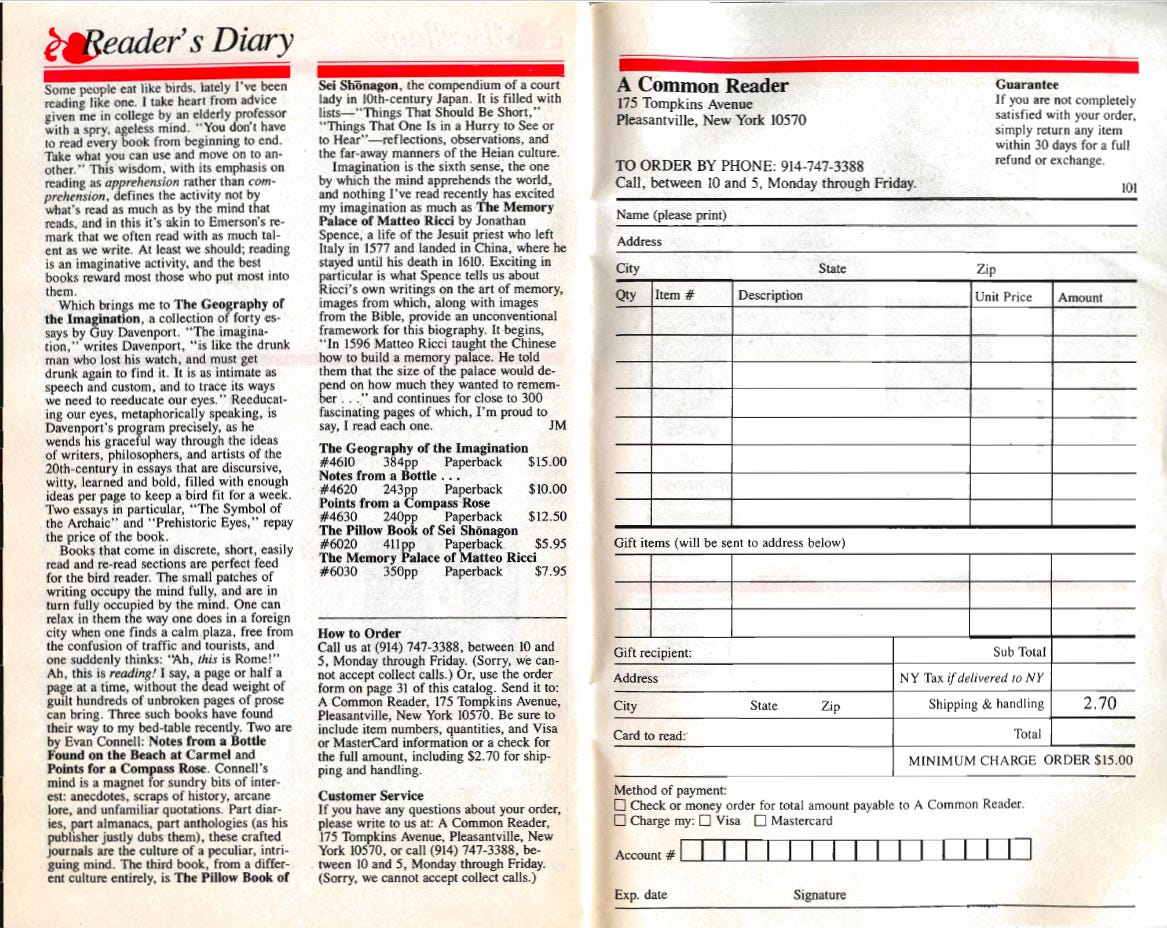
Reader’s Diary: 1986
I suppose I shouldn’t be surprised to find, in the diary that appears as the last word in that first catalog (and whose opening line contributes the first sentence of the piece you are reading), a kind of continuity with the reading and writing life that’s been my vocation ever since. It’s encouraging to detect scattered through it, unexpectedly now and certainly without intent at the time it was written, seeds of the project that would be published thirty-two years later as 1,000 Books to Read Before You Die. Before commenting further, let me share with you the complete diary entry as it originally appeared (which I’ve restrained myself from amending upon rediscovery):
Some people eat like birds, lately I’ve been reading like one. I take heart from advice given me in college by an elderly professor with a spry, ageless mind. “You don’t have to read every book from beginning to end. Take what you can use and move on to another.” This wisdom, with its emphasis on reading as apprehension rather than comprehension, defines the activity not by what’s read as much as by the mind that reads, and in this it’s akin to Emerson’s remark that we often read with as much talent as we write. At least we should; reading is an imaginative activity, and the best books reward most those who put most into them.
Which brings me to The Geography of the Imagination, a collection of forty essays by Guy Davenport. “The imagination,” writes Davenport, “is like the drunk man who lost his watch, and must get drunk again to find it. It is as intimate as speech and custom, and to trace its ways we need to reeducate our eyes.” Reeducating our eyes, metaphorically speaking, is Davenport’s program precisely, as he wends his graceful way through the ideas of writers, philosophers, and artists of the 20th century in essays that are discursive, witty, learned and bold, filled with enough ideas per page to keep a bird fit for a week. Two essays in particular, “The Symbol of the Archaic” and “Prehistoric Eyes,” repay the price of the book.
Books that come in discrete, short, easily read and re-read sections are perfect feed for the bird reader. The small patches of writing occupy the mind fully, and are in turn fully occupied by the mind. One can relax in them the way one does in a foreign city when one finds a calm plaza, free from the confusion of traffic and tourists, and one suddenly thinks: “Ah, this is Rome!” Ah, this is reading! I say, a page or half-page at a time, without the dead weight of guilt hundreds of unbroken pages of prose can bring. Three such books have found their way to my bed-table recently. Two are by Evan Connell: Notes from a Bottle Found on the Beach at Carmel and Points for a Compass Rose. Connell’s mind is a magnet for sundry bits of interest: anecdotes, scraps of history, arcane lore, and unfamiliar quotations. Part diaries, part almanacs, part anthologies (as his publisher justly dubs them), these crafted journals are the culture of a peculiar, intriguing mind. The third book, from a different culture entirely, is The Pillow Book of Sei Shōnagon, the compendium of a court lady in tenth-century Japan. It is filled with lists—“Things That Should Be Short,” “Things That One Is in a Hurry to See or to Hear”—reflections, observations, and the far-away manners of the Heian culture.
Imagination is the sixth sense, the one by which the mind apprehends the world, and nothing I’ve read recently has excited my imagination as much as The Memory Palace of Matteo Ricci by Jonathan Spence, a life of the Jesuit priest who left Italy in 1577 and landed in China, where he stayed until his death in 1610. Exciting in particular is what Spence tells us about Ricci’s own writings on the art of memory, images from which, along with images from the Bible, provide an unconventional framework for this biography. It begins, “In 1596 Matteo Riccio taught the Chinese how to build a memory palace. He told them that the size of the palace would depend on how much they wanted to remember . . .” and continues for close to 300 fascinating pages of which, I’m proud to say, I read each one.
The seeds of my later book project are found in two specific titles, The Geography of the Imagination and The Pillow Book of Sei Shōnagon, each of which earned a place among my thousand; a more important seed, however, is the dichotomy between apprehension and comprehension in reading, something that became so ingrained in my approach to literary art that forms of the verb “apprehend” appeared with frightening frequency in the original drafts for 1,000 Books, earning repeated excision through an aggravated persistence on the part of my editor (the overindulgence in “apprehension” was one byproduct of writing a book in pieces across fourteen years). It became enough of a joke between us that, when our book was finally complete, I gave her a copy of Sir Arthur Quiller-Couch’s treatise, On the Art of Reading, in the pages of which I’d first come across the distinction. “For all great Literature, I would lastly observe,” writes Sir Arthur, “is gentle towards that spirit which learns of it. It teaches by apprehension, not by comprehension—which is what many philosophers try to do, and, in trying, break their jugs and spill the contents.”
Apprehension, even in its sense of foreboding, is a tool of discovery which grants its object a life of its own, whereas comprehension is a mastery that seeks to pin its objects down for dissection. (“The great human error,” Simone Weil said, “is to reason in place of finding out.”) Reading for me was to engage the world’s incorrigible plurality without fencing it within the limits of my own perspective or projecting it into predetermined categories. To make a living doing it required a leap of faith that would carry me beyond the reach of the academy, where reading was meant to be comprehensive in every direction, or so it seemed to me, no doubt unfairly, as I came to the end of my undergraduate studies so long ago.
“Wondering about how readers react to books is not exactly encouraged in traditional literature programs,” writes Karolina Watroba in “The Anxiety of Difficulty: On Trying to Read Thomas Mann,” a terrific piece on being daunted by The Magic Mountain that was published a few years ago in The Point. “Students can sense their professors’ discomfort whenever somebody mentions a ‘personal experience’ while discussing a text in class—like a time in their life the book reminded them of, or how it made them sad or angry.” I know what she means; it was the impersonal authority of academia that had spooked me in college, scaring away everything that made books both useful and meaningful to me.
Sizing up the stance of my younger self in the words of the “Reader’s Diary” that concluded the inaugural instance of our quixotic catalog project, I realize now what I was really up to, unbeknownst to myself: trying to make a space for a writing voice I’d not yet found, but felt the need to fashion—a place to think out loud in prose, close enough in dimension to make a small voice resonant, yet open enough in opportunity for a modest audience to overhear it.
I have fond memories of getting the catalogs and scratching out lists that I had to winnow down to an affordable few. The best thing about the selections was that there were few limits when it came to period or genre: every issue was full of reminders that there have been terrific books written and published in every era and category.
Folks can find a list of all the books published by the Akadine Press as Common Reader Editions here: https://neglectedbooks.com/?page_id=57
I really miss A Common Reader. I bought so many books based on your descriptions.