
Landscape and Letters
Notes from an archive: Tuscan reveries recalled.

This installment—in which I read Genealogy of the Pagan Gods and admire the Tuscan countryside; am transported by a full moon; visit the Boccaccio museum and ponder the lessons of his Decameron—picks up where the last, A Taste for Tripe and Timeless Ways, left off.
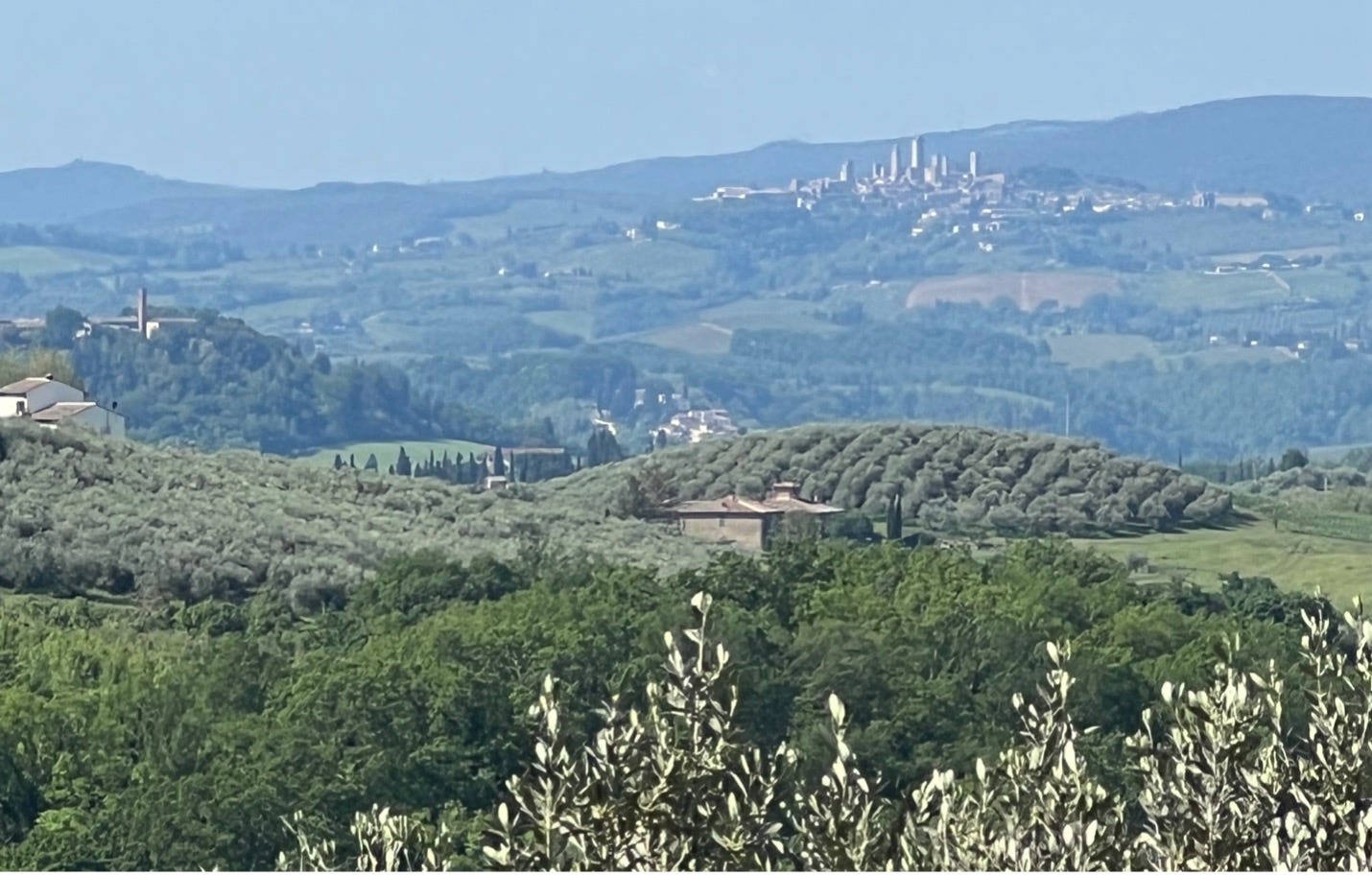
5 :: Morning :: I sat on the terrace of the Villa Orchidea intending to read the copy of Boccaccio’s Genealogy of the Pagan Gods that I’d carried from America to this spot not far from the town of Certaldo, where the author spent a good part of his life. But I didn’t even open the book. A chorus of birds went about its music; what sounded like the hoot of an owl (more likely a mourning dove) slid over the layered twittering of the dozens of small creatures I saw floating and fluttering between the trees. The air was soft, palpably soft, as if weathered by time and use; clouds cushioned the dark ridge on the horizon. Before me the bole of an umbrella pine displayed its character in the strips of bark arrayed like a mosaic of encrusted brush strokes, each ridged with time’s organic attention. Behind this pine was another, and maybe twenty yards beyond it were two more, each with a split trunk; to the left of the one on the left a single cypress, erect in its Tuscan elegance, stretched upward in deep green confidence just beneath the lighter greenery of the pine’s umbrella. The silvery green of an olive tree, intent in its intricacies of untapped flavor, was also in view, and beyond that the vernal expanse of a valley bedded with trees; then a tilled field and another olive grove, together obscuring a hidden valley and leading the eye toward a distant hill at whose summit—or perhaps it was the summit of a hill even farther beyond—rose the medieval towers of San Gimignano, their blocky certitude a small assertion of will against the grace of cultivation that dominated my view. To the right faraway hillsides, dotted with buildings, dappled in shadow, shouldered the burden of thousands of years and the lives that marked them in labor or leisure, a landscape that has been worked close up but is still—by magic or by art—designed for the eye that finds it from far away. The fine Italian hand may have no suppler legacy.
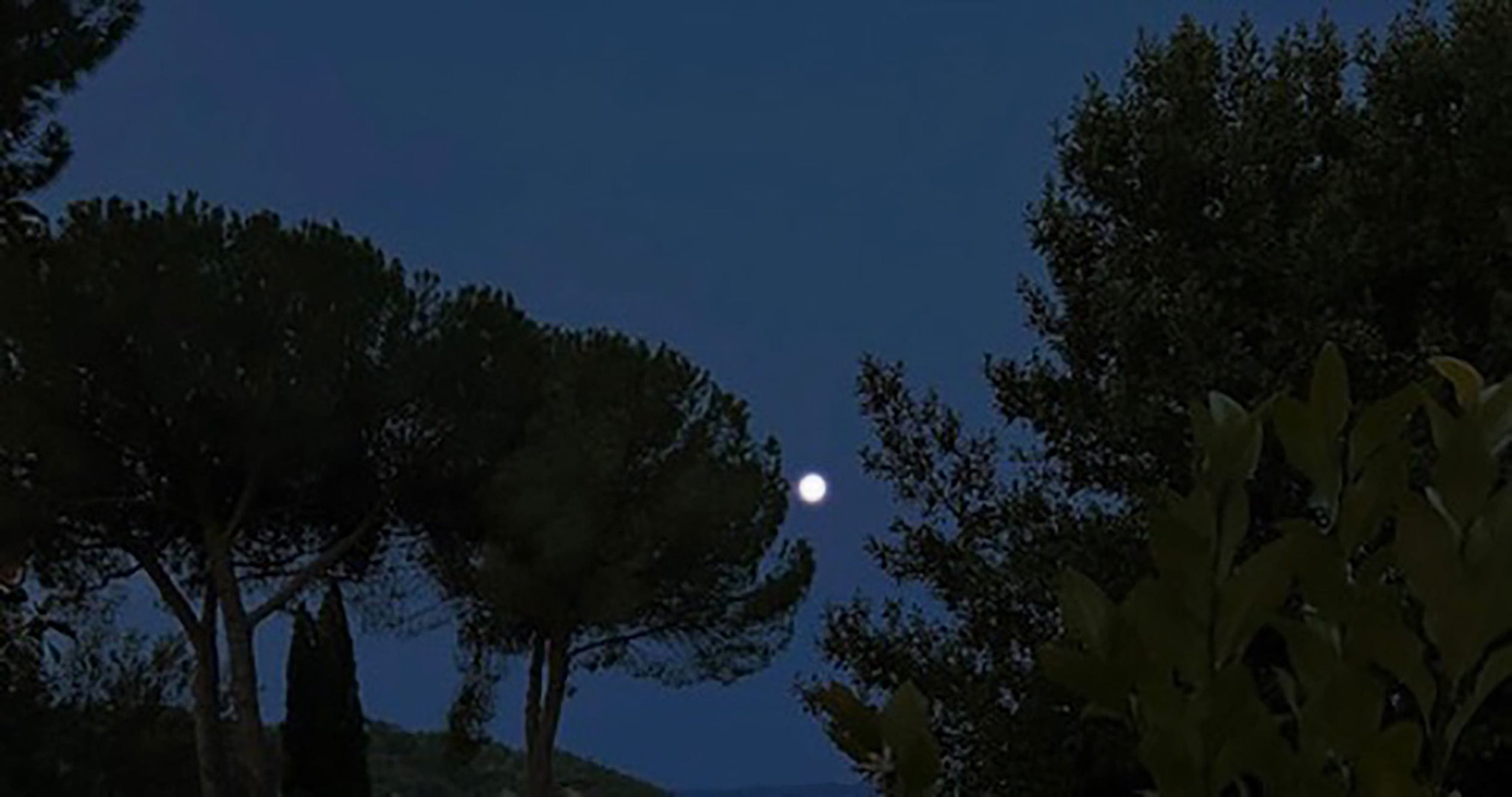
6 :: A Full Moon :: Awakening in the middle of the night, I found the room awash in light. I walked to the window that looked out over the valley. Slipping into the space between the half-open shutter and the wall, I saw the full moon above the olive grove, its illumination softening the darkness of the sky to a warm, deep blue. Down to earth, it gently alerted the trees and the surrounding grounds to the reflective presence that is hidden in the glare of days but can still be conjured by moonlight in the watches of the small hours: the hallowed vigilance of the world. It might have been, I think, the same nocturnal light upon the Tuscan countryside that Dante knew as he mooned for Beatrice, or that Petrarch, lunatic for love of Laura, invoked in one of his Scattered Rhymes (as Peter Thornton names them in his translation of the Canzoniere):
Deh or foss’io col vago de la luna
adormentato in qua’ che verdi boschi,
et questa ch’anzi vespro a me fa sera,
con essa et con Amor in quella piaggia
sola venisse a starsi ivi una notte;
e ’l dí si stesse e ’l sol sempre ne l’onde.
If only with the lover of the moon
I now lay fast asleep in some green woods,
and she who in high days brings on my evening
would, with the moon and Love, visit that meadow
and stay there for the length of one whole night,
the sun and day forever beneath the waves!
The myth of Endymion—the shepherd so alluring when asleep beneath the night sky’s shimmer that the goddess of the moon implored Zeus to make him slumber forever—was so strongly present to Petrarch’s mind that the poet didn’t have to mention its subject by name to emulate the attraction the tale evokes, but merely summon its imagery to give voice to a longing that would long outlast him: “Oh how I need,” he could be singing, “someone to watch over me.”
The poet’s friend and correspondent, Giovanni Boccaccio, as if annotating this verse for later generations, provides the mythological roots of Endymion’s story in his Genealogy, invoking scholarly variants that bring our dormant shepherd to life as more than just an object of devotion. Elsewhere we learn—from that old Roman empiricist Pliny, for one—that Endymion was a subject in his own right, a pioneer astronomer, the first human, as Boccaccio shares from his reading of Fulgentius, to chart the course of the moon, the shepherd’s intelligence as enchanted by the satellite as its deity’s gaze was by his recumbent handsomeness. In fact, Boccaccio suggests with Tuscan bluntness that Endymion’s apparent enchantment has a different explanation than the commonly accepted one: the shepherd “is said to have slept for thirty years,” he writes, “because stupid people assume that those who spend their time in deep thought are asleep.”
Lengthy meditations—on lunar themes or songs of love, or on the lore and literature of the classical world they were keen to uncover in their insatiable humanist book hunting—were certainly the province of Petrarch and Boccaccio, his younger acolyte, as they had also been, in a more exalted way, of Dante, their elder by two generations. All three were native Tuscans, and all three traded Latin for the common tongue in shaping literary remains—Dante his Commedia, Petrarch his Canzoniere, and Boccaccio his Decameron—that would last far enough into the future to ensure the fortune of the Italian language and expand the means, and the meaning, of literary endeavor.
Dante’s great work, of course, puts him in a class by himself. Although his commedia only became “divina” once Boccaccio dubbed it so, its focus on the afterlife (replete as it is with the settling of earthly accounts and political scores), takes his imagination somehow beyond the reach of the pursuit of elusive love and the pursuit of lost learning that are the twin impulses of the humanistic creed Petrarch and Boccaccio practiced. That the first pursuit was largely on the page, and the second a hands-on adventure story involving the recovery and deciphering of manuscripts fabled but forgotten, makes their devotion to letters a paradoxical calling, the elements of heart and mind so mixed in it that nature might call it a definition of the human.
Or so some sleepy portion of my head imagined as I watched the illuminated landscape not far outside Certaldo, fancying how Dante, Petrarch, and Boccaccio might have wished on this same moon for the inspiration to tune the vernacular to a higher pitch, a language that might be held responsible to experience in a new way, ennobling both tellers and their tales. By the once encompassing, now fading beam of that legacy my own life has been lit, if not always made clear; whatever small meaning I’ve learned how to make has been made in the shadow of its distant spell.
7 :: Tuscan Letters :: A couple of days later, I stood before a large touchscreen in the Casa Boccaccio, a small museum housed in the restored remains of the building that, nearly seven hundred years ago, was the author’s home for the last decade of his life. The museum is in Certaldo Alto, a walled city perched in stony nobility on the hills that divide the Val d’Elsa from the Val di Pesa, its medieval profile poised in elegant, stoic simplicity above the modern Certaldo of car traffic and commercial necessities—pharmacies, insurance offices, a co-op supermarket—below.
Illuminated on the screen was a blown-up image of a manuscript page that the museum’s director, Martina Dani, had summoned for me to look at, after understanding, through the cloud of my poorly pronounced Italian that she and Clara Conforti, Certaldo’s councilor for culture, had pierced to understand that I had a particular interest in Genealogy of the Pagan Gods, which had entranced me with the mix of fable and scholarship it combines into a patterned catalogue of story, assembled by Boccaccio from the fabrics, and sometimes the mere threads, his humanist gleaning had collected.
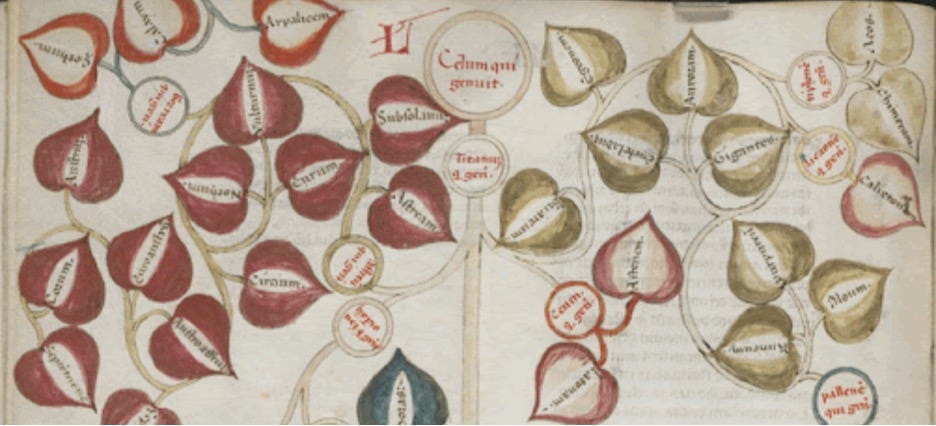
The illustration she’d called up with a few deft swipes of arm and hand depicted in graphic abstract the entangled relations of divine and mortal affairs: a vine with curving tendrils, its pendant green and red leaves arranged to represent the deities and their descendants, denizens of the fabulous domains of classical mythology that Boccaccio maps in his compendium, an encyclopedia of tales and commentary revealing the intricacies of love and trouble Greek and Roman myths encode. A dozen or so such artful diagrams grace Boccaccio’s cartography of the ancient imagination; according to scholars (notably Ernest H. Wilkins, writing in the journal Modern Philology in 1925), they may be the earliest representations of genealogical lines of descent in the form of a plant, and thereby progenitors of the family trees with which we have come to trace the roots and branches of ancestry, species, history, knowledge.
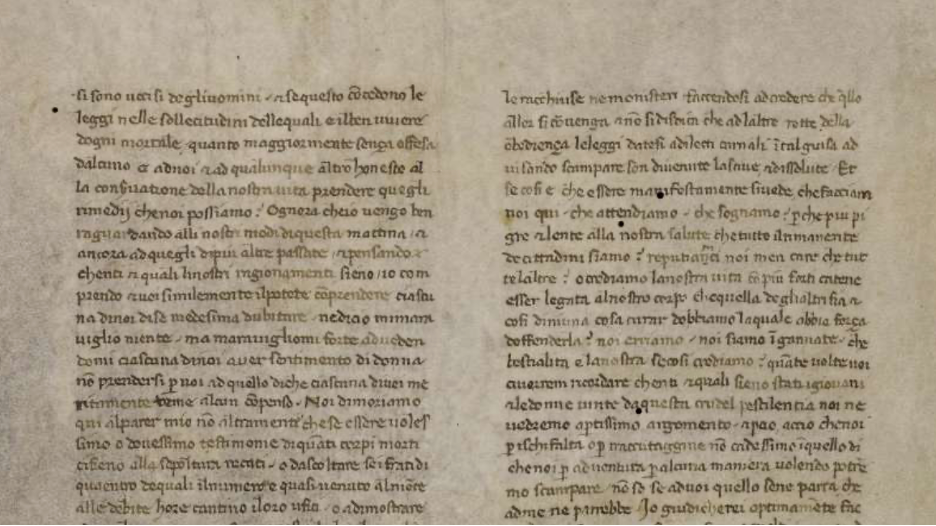
When I mentioned that I had been unaware of the storyteller’s penchant for picture-making, Martina quickly brought to the screen other examples of his handiwork: a manicule with which he highlighted passages in his manuscripts, caricatures he drew in the margins of the Decameron, other decorations. To illustrate her point, she produced a two-columned page of the Decameron written in the author’s own hand. Seeing how intrigued I was by it, she moved to one of the shelf-lined walls to pull out a large volume that held a facsimile of the manuscript projected upon the screen.
We were standing in a fairly spacious but modest room lined on three sides with gated bookshelves; display cases exhibiting some of the museum’s treasures occupied the center of the space. Along one wall were editions of the Decameron in nearly every language, from Arabic to Yiddish, Bulgarian to Vietnamese, plus a smaller section devoted to Boccaccio’s various other works of verse and prose. The other walls ordered critical and scholarly studies from across the centuries. The volume Martina pulled from a stack of oversized tomes and placed on top of an exhibition case for me to peruse was a reproduction of Boccaccio’s final manuscript of the Decameron, inscribed by him in this very house, or, more exactly, in the building that occupied the site on which we currently stood when he retreated to Certaldo from the intrigues of Florentine politics in 1361 (a World War II bombing having necessitated a reconstruction).
At first glance, the hand-lettered manuscripts of this period are both wonders of precision and indecipherable masses of text, the words indistinguishable to modern eyes accustomed to the signposts afforded by normalized word spacing, paragraph breaks, and other refinements of modern typography. A page appears to be an inventory rather than a text, a warehouse of words packed as tightly as possible, hoarding meaning as much as sharing it, as if keeping it under wraps until print might come along to assist in its distribution. I bent down over the large folio open in front of me for a closer look, bewitched by the handiwork of the letter forms. These are nicely shaped, discrete, consistent, compact—clearly descended from the Caroline minuscule of the medieval monks Charlemagne browbeat and cheer-led into ever more articulate routines of literacy a few hundred years before Boccaccio’s invention found a page. In fact, the legibility of the Carolingian hand became a model for the humanist book hunters as they copied their way backward through ancient texts and forward toward the Renaissance; it provided as well the inspiration for most of the fonts we still see in volumes today.
I perused a spread of two double-columned sheets, each column containing fifty-three lines, every line penned with attention. My eyes sought a semantic purchase but quickly wandered off in more general wonder at the physical encryption of imaginative life. The feat of copying daunted me: what dextrous concentration it captured. My fingers flexed with the vicarious ache of someone else’s effort, his dedication to transmitting his culture by hand.
The masterpiece these carefully formed letters inscribed in the early 1370s had been composed more than a decade earlier, and it made its author’s reputation. It tells—here I crib from my Decameron entry in 1,000 Books to Read Before You Die—of a group of Florentine aristocrats, seven women and three men, who flee the city, retreating to a villa in the countryside to escape the ravages of the Black Death (the bubonic plague that claimed the lives of more than half of Florence’s denizens in the middle of the fourteenth century). Having taken their bodies out of harm’s way, they devote their minds to a round robin of story, telling one tale apiece on each of ten nights devoted to diversion. Like Scheherazade, they discover that storytelling offers more than escape from harsh realities: in the leisurely urgency of their invention, stories provide the most beguiling way of embracing—and extending—the hardiness of living.
Many of the narratives in the Decameron are famously ribald, and all the more life-affirming for their avowal of the pleasures of the flesh. Boccaccio’s endlessly ingenious euphemistic evocation of sexual activity enlivens his characters’ accounts of lovers faithful or conniving, clergy faithless and conniving, and all manner of jokers and schemers, but his gift for carnal metaphor is only one example of the colloquial genius that courses through the tales. The vitality of Boccaccio’s writing exhibits for the first time in prose, really, the literary vigor of the Italian vernacular, roughly three decades after Dante had done the same in poetry by eschewing Latin in the composition of The Divine Comedy. The Decameron’s comedy, in contrast, is very much a human one: where Dante articulates medieval ideals, encompassing both sin and love in a theological vision calibrated in one hundred carefully wrought verse cantos, Boccaccio celebrates, in his one hundred prose narratives, the more worldly urges—mercantile, calculating, crafty, erotic—of the dawning Renaissance, unashamedly rescuing sin from hell and love from heaven. What Dante sends spinning into ethereal realms, Boccaccio gleefully brings back to earth for readers to recognize as their own worldly, incorrigible, and, often enough, happy inheritance.
Unlike Dante’s otherworldly calibrations of spiritual passage, or Petrarch’s contemporary renderings of longing in structured sonnets, Boccaccio’s catalogue of lust and love and greed and guile and generosity and pleasure transforms the transient character of everyday life into something lasting, and it does so by accommodating speech and its rhythms into the flow of its narrative. His vernacular style in the Decameron, unlike that of the Latin in which he would compose the Genealogy and many other works, adopts a manner adept at changing tones, moving from the profane to the pious and often lingering between the two—or veering into another register entirely—as the cunning of his protagonists demands. Where the verse of his literary forebears carefully observed its forms, Boccaccio’s prose was free to wander through Florentine experience, incorporating its variety from the noisy hubbub of the markets to the quiet etiquette of aristocratic lairs. It was a tool that could spew witticism and invective as it captured the ingenuity of minds—and yes, bodies—as they made their way in a rough and not always ready world. Enlivened with the then uncommon touch of common language, his sentences allowed him to bring experience to the page with something that felt like realism.
“A novel is a mind aware of a world,” writes William H. Gass in his essay “Representation and the War for Reality.” Words create that world and sentences provide the means of moving through it; Boccaccio’s sentences brought a new sophistication to their making. “‘Art’ fiction in prose took centuries to come of age,” wrote Joan Acocella in a brilliant review of Wayne A. Rebhorn’s splendid translation of the Decameron, “because medieval writers, like the ancients, considered prose inferior to verse for the purposes of imaginative literature. Today, it is the primary medium of literary writing: novels, short stories. In Italy, the pioneer of that change was Boccaccio.”
I’ll make an even bigger claim for the prose Boccaccio pioneered, one that reaches beyond the borders of Italy and beyond the bounds not only of literary writing, but even of volumes. A sentence moving through a world embodies a consciousness on the make, a figure engaged in self-fashioning akin to that pursued by Dante through his dark wood and by Petrarch in his ascent of Mont Ventoux; prose, especially vernacular prose, could set such a quest, with all its comic and local—as well cosmic and spiritual—possibilities, surely in the here-and-now in a way that poetry, for all the fair and fitting fictive garments in which it could veil truth (in Boccaccio’s own wonderful phrase), was too fussy to hold fast. What Boccaccio pioneered in the Decameron was a fresh way to make human awareness, through language, responsible to life.
Boccaccio begin writing the Decameron at the very end of the 1340s and finished a couple of years later. He never really wrote prose fiction again. While he was composing it, he met Petrarch in the Florentine countryside (the poet was en route to Rome), and then spent some weeks at Petrarch’s home in Padua. An increasingly rich correspondence—about manuscript discoveries, literary themes, political issues, ascetic aspirations (both men would take holy orders late in life)—ensued. With the celebrated older man as mentor, Boccaccio fell even more eagerly into line behind the standards of classical learning and ancient eloquence that scholar adventurers had pulled, often in tatters, from the dustbins of monasteries, then mended and lifted as humanist banners in the parade of intellectual history heading toward the Renaissance.
One result of Boccaccio’s allegiance to these ideals was the Genealogy of the Pagan Gods, begun after his initial encounters with Petrarch, which, as Jon Solomon writes in the introduction to his ongoing definitive modern edition of the work, “were dramatically transforming Boccaccio’s literary focus from vernacular Italian romance and poetry to scholarly Latin prose treatises.” The Genealogy is a monument of humanist enterprise, assiduous in its tracing, through the tales and commentaries of ancient authors, of the mythological constellations that shone in the heavens of the classical imagination. A work of scholarship and erudition, it is both a thesaurus of story and a variorum gallery of the gods. While lacking the liveliness (and, I’ll say it, the interest) of the Decameron, the Genealogy retains a fascination nonetheless; it is notable today especially for its final two (of fifteen) books, in which the author offers an apology for poetry that echoed across time and space to inform similar advocacy by the Elizabethan poet Sir Philip Sidney in the late sixteenth century and the Romantic poet Percy Bysshe Shelley nearly two-and-a-half centuries later.
Boccaccio worked on these concluding books in Certaldo toward the end of his life, as if he were debating the value of the preoccupations to which he had devoted such a large portion of his days. In fact, after completing the Decameron and embarking upon the Genealogy, he suffered through a spiritual reckoning, questioning his reverence for the ancients and his devotion to words. “In one strange episode,” Sarah Bakewell writes in her book Humanly Possible,
Boccaccio came close to abandoning it all. A monk, Pietro Petroni of Siena, warned him in 1362 that he would die imminently if he did not get rid of all the non-Christian books in his library and stop writing such books himself. This had been revealed to Pietro in a vision. Alarmed, Boccaccio sought advice from Petrarch, who talked him down from his panic.
The older poet did this by responding, essentially, “If you must get rid of your books, send them to me.”
Legend has it that during his crisis of conscience Boccaccio considered disowning the Decameron as a foolish, faithless thing. But shortly before his death, he revised the work and made a fair copy by hand. It was a facsimile of this last manuscript I was shown by Martina Dani and Clara Conforti in Certaldo, and I imagined the old man bent over a desk at his labors, carefully forming every element of the many thousands of words that made the sentences by which he transformed the petty lusts and exuberant energies of his characters—and all of Florence—into fiction that would last forever, or close enough, caressing the letters as if he could not let them go.
To be continued: the third and final installment of this series—in which I climb Boccaccio’s tower; meditate on the past and future of literary expression; head to lunch (where I order more tripe); recall conversations with famous chefs; and savor boyhood good fortune—will appear next time.
Thanks Jim ! I’ll not get to Italy this year but you just took me there over coffee! Fantastic!
this is great!